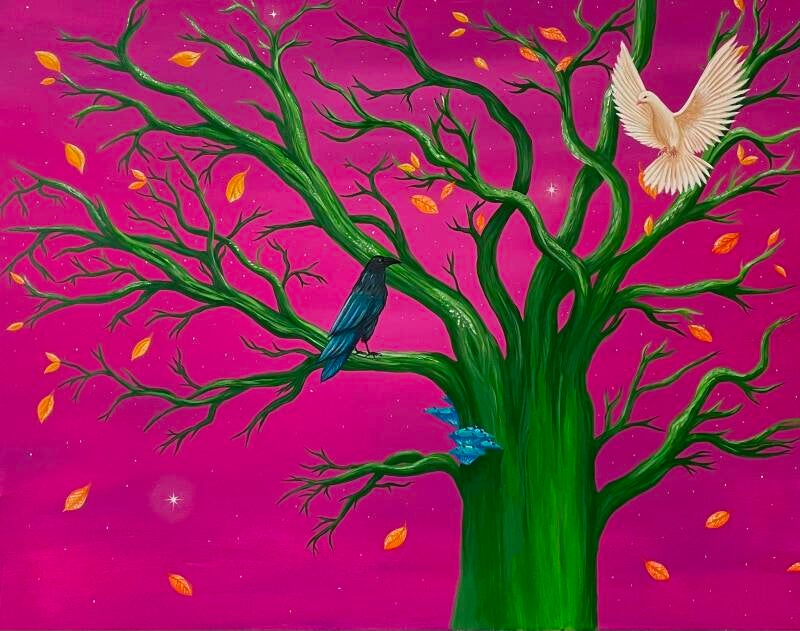
To understand the subject of this painting, it is important to first understand what Yin & Yang means. Yin & Yang is a fundamental concept in Chinese philosophy. The Yin-Yang philosophy assumes that, in the beginning, there existed an original, unified force or matter known as Qi. This Qi divides into two opposing forces:
Yin traditionally represents the dark, heavy, quiet, cool, receptive, passive, and feminine, as well as everything that is directed more inward and downward.
Yang, on the other hand, represents the bright, light, warm, active, dynamic, creative, and masculine, as well as everything that is directed more outward and upward.
From their interaction, Heaven and Earth emerge, as well as all other opposites in the world, such as male and female, the sun and the moon, day and night, or activity and rest. Yin is not “bad” and Yang is not “good” – both are necessary and complement one another. They cannot exist independently and are dependent on each other. They are also constantly changing and can transform into one another. A balanced and harmonious state arises when Yin & Yang exist in an appropriate relationship with one another. The goal, therefore, is not for one to dominate the other, but for both to exist in balance. Taiji refers to the original unity from which Yin and Yang emerge and to which they ultimately return as a whole. (Scheid, 2026)
The Meaning of the Motifs
Now that we have a better understanding of Yin & Yang, we can turn our attention to the individual details of the painting. On this fully painted canvas, the individual motifs are impossible to overlook and can be perceived as more than what they initially appear to be. A bare tree, yellow falling leaves, and two birds that we recognize as a raven and a dove. Yes, it is clearly an autumn scene – but what deeper meaning lies behind it?
Autumn represents the end of summer and, at the same time, the beginning of winter. An ending cannot exist without a beginning. The branches of the bare tree reach out as if they were trying to grasp something far above them, while the yellow leaves are falling, slowly descending toward the ground. Just as in Yin & Yang, the ascending and descending meet in the same moment.
And yet, nothing is moving. Everything is still, because what we see is only a painting, a canvas. These opposites exist simultaneously within the same moment: movement and stillness.
These opposites also become apparent in the two birds. The raven sits quietly on a branch and is positioned lower within the composition than the dove, which is caught in mid-flight, right in the midst of movement. The birds therefore become the most apparent symbol of Yin & Yang.
The raven represents Yin: the dark, quiet, cool, receptive, passive and feminine.
The dove represents Yang: the bright, light, warm, active, dynamic, creative and masculine.
A contrast can even be found in the German language itself. Yin is represented by “der Rabe” (the raven), which grammatically has a masculine article, even though the raven represents the feminine. The same applies to the dove: in German, it is “die Taube”, with a feminine article, yet here it represents the masculine. Perhaps this is where the true meaning of Yin & Yang reveals itself: opposites can exist together in balance.
“Knowledge has two wings; conjecture has only one.”
– Jalāl al-Dīn Rūmī, Masnavi, Book III, Verse 1510
Original:
علم را دو پر گمان را یک پرست
ʿelm rā do par, gomān rā yek par ast
References:
Scheid, B. (2026, 2. Oktober). Yin und Yang. Religion in Japan: Ein digitales Handbuch. Universität Wien. https://religion-in-japan.univie.ac.at/Handbuch/Grundbegriffe/Yin_und_Yang